RECENTLY ADDED
Student Loan Repayments
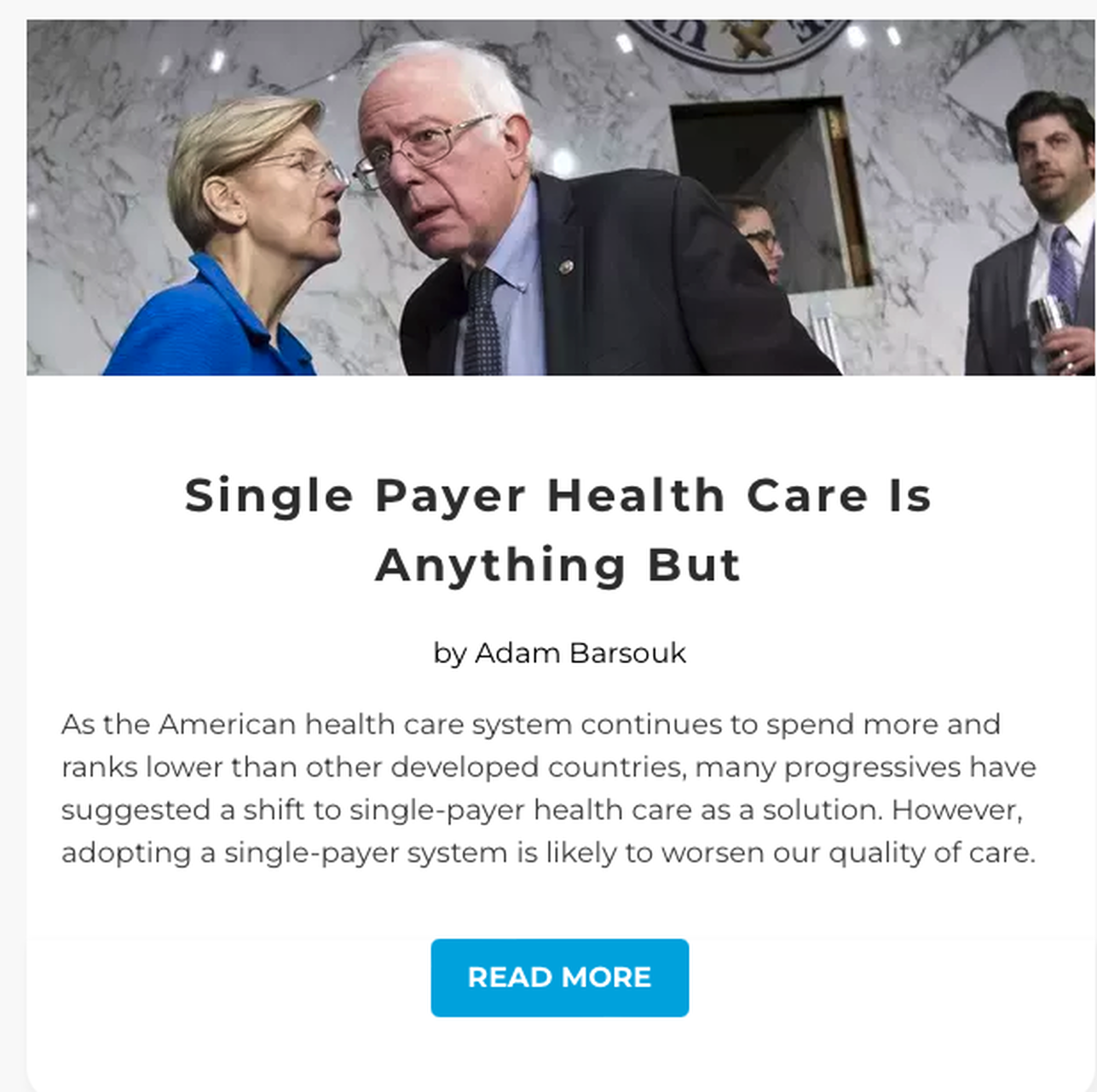
Bernie Sanders claims it’s “unacceptable” that “student loan payments will go up as much as $4,000 a year” due to “Trump and his “Big Beautiful Bill.”
IN FACT, the federal student loan program has enriched colleges with declining standards while allowing borrowers to shift their debts to taxpayers. The BBB limits this by capping loans amounts and requiring repayment at bargain rates. Here are the specifics:
• In 1965, Congress and Democrat President Lyndon B. Johnson created a programto finance student loans for higher education via private lenders with the debts guaranteed against default by the federal government.
• Per the U.S. Treasury, governments create loan programs so that people who are “unable to afford credit at the market rate” or have a “high risk” of defaulting can borrow money at “an interest rate lower than the market rate.”
• Per the Congressional Budget Office, “When the government extends credit, the associated market risk of those obligations is effectively passed along to citizens.”
• In 1993, Congressional Democrats and Bill Clinton created a program to finance student loans directly from the U.S. Treasury and required that increasing portions of all new federal student loans be made through this program.
• In 2010, Congressional Democrats and Barack Obama passed a law requiring that all new federal student loans be financed directly from the U.S. Treasury.
• Per Deborah J. Lucas, director of the MIT Center for Finance and Policy and former chief economist of the Congressional Budget Office, “Government credit programs may have adverse consequences that must be weighed against their expected benefits,” and “some observers point to the easy and low-cost access to federal student loans as fueling the steep rise in the cost of higher education.”
• From 2003 to 2021, inflation-adjusted total student loan debt more than quadrupled from $0.4 trillion to $1.8 trillion.
• Since 2010, inflation-adjusted average annual spending per student at 4-year public colleges has risen from $52,305 to $63,159, with only 24% of this spending used for student instruction.
• Since 2010, inflation-adjusted average annual spending per student at 4-year non-profit colleges has risen from $67,238 to $82,116, with only 27% of this spending used for student instruction.
• In addition to student loans, federal, state and local governments spent $237 billion on higher education in 2022, or 87% of all spending by public and private colleges on functions that directly contribute to the education of students and the general public.
• As student loan amounts and college costs rose, Obama and Biden issued a flurry of regulations and directives that transferred the debts of student loan borrowers to taxpayers.
• In 2022, Biden announced that he is “forgiving” $20,000 of student loan debt for the vast bulk of Pell Grant recipients and $10,000 for most others who owe student loans.
• Biden’s fiat — which flagrantly defied federal law — would have cost taxpayers$605 billion to more than $1 trillion, or an average of $4,700 to $7,700 for every household in the nation.
• After the Supreme Court struck down Biden’s illegal decree in 2023, Biden continued taking other executive actions to transfer student loan debts to taxpayers.
• In 2025, Congressional Republicans and Donald Trump passed the One Big Beautiful Bill Act, which prevents post-graduate students from unlimited borrowing by placing a lifetime student loan cap of $100,000 for grad students and $200,000 for professional students who study to become doctors, dentists, veterinarians, etc.
• The BBB also replaced a patchwork of “more than 40 repayment and discharge options” with two major options: (1) pay the loan back in the standard 10-year timeframe, or (2) pay it back based on your income.
• Under the income-based option, monthly payments are at least $10 and range from 1% to 10% of borrowers’ incomes with the “applicable percentage increasing by one percentage point” as income rises by $10,000.
• Thus, a person making $10,000 a year would pay no more than $10 per month. A person earning $50,000 per year would pay a maximum of 5% of their income, or no more than $208 per month. A person earning $100,000 per year would pay a maximum of 10% of their income, or no more than $833 per month.
• Also, monthly payments are reduced by $50 for each dependent of the borrower. Thus, a person with two dependents and $70,000 in income would pay no more than $308 per month.
• Also, the BBB waives interest in certain cases when “borrowers make on-time monthly payments, ending the cycle of payments that do little to reduce loan balances.”
• As the federal government became progressively more involved in higher education, the average time spent by full-time college students on educational activities like attending class and studying dropped from roughly 40 hours per week in 1961 to 27 hours per week in 2003.
• In 2005–2007, full-time students at 4-year colleges spent an average of 27–28 hours per week on educational activities and 43 hours per week on leisure activities and sports.
• A 2003 assessment of the literacy skills of graduating college students found that only 39% of males and 30% of females at 4-year colleges were proficient in quantitative literacy, which is the ability to “identify and perform computations” using “numbers embedded in printed materials,” such as “balancing a checkbook, figuring out a tip, completing an order form, or determining the amount of interest on a loan from an advertisement.”
• Entry-and-exit assessments of the “critical thinking, complex reasoning, and writing skills” of full-time students who entered 4-year colleges in 2005 and graduated in 2009 found that approximately one-third them didn’t improve their skills by more than one percentage point “over four years of college.”
Bernie Sanders claims it’s “unacceptable” that “student loan payments will go up as much as $4,000 a year” due to “Trump and his “Big Beautiful Bill.”
IN FACT, the federal student loan program has enriched colleges with declining standards while allowing borrowers to shift their debts to taxpayers. The BBB limits this by capping loans amounts and requiring repayment at bargain rates. Here are the specifics:
• In 1965, Congress and Democrat President Lyndon B. Johnson created a programto finance student loans for higher education via private lenders with the debts guaranteed against default by the federal government.
• Per the U.S. Treasury, governments create loan programs so that people who are “unable to afford credit at the market rate” or have a “high risk” of defaulting can borrow money at “an interest rate lower than the market rate.”
• Per the Congressional Budget Office, “When the government extends credit, the associated market risk of those obligations is effectively passed along to citizens.”
• In 1993, Congressional Democrats and Bill Clinton created a program to finance student loans directly from the U.S. Treasury and required that increasing portions of all new federal student loans be made through this program.
• In 2010, Congressional Democrats and Barack Obama passed a law requiring that all new federal student loans be financed directly from the U.S. Treasury.
• Per Deborah J. Lucas, director of the MIT Center for Finance and Policy and former chief economist of the Congressional Budget Office, “Government credit programs may have adverse consequences that must be weighed against their expected benefits,” and “some observers point to the easy and low-cost access to federal student loans as fueling the steep rise in the cost of higher education.”
• From 2003 to 2021, inflation-adjusted total student loan debt more than quadrupled from $0.4 trillion to $1.8 trillion.
• Since 2010, inflation-adjusted average annual spending per student at 4-year public colleges has risen from $52,305 to $63,159, with only 24% of this spending used for student instruction.
• Since 2010, inflation-adjusted average annual spending per student at 4-year non-profit colleges has risen from $67,238 to $82,116, with only 27% of this spending used for student instruction.
• In addition to student loans, federal, state and local governments spent $237 billion on higher education in 2022, or 87% of all spending by public and private colleges on functions that directly contribute to the education of students and the general public.
• As student loan amounts and college costs rose, Obama and Biden issued a flurry of regulations and directives that transferred the debts of student loan borrowers to taxpayers.
• In 2022, Biden announced that he is “forgiving” $20,000 of student loan debt for the vast bulk of Pell Grant recipients and $10,000 for most others who owe student loans.
• Biden’s fiat — which flagrantly defied federal law — would have cost taxpayers$605 billion to more than $1 trillion, or an average of $4,700 to $7,700 for every household in the nation.
• After the Supreme Court struck down Biden’s illegal decree in 2023, Biden continued taking other executive actions to transfer student loan debts to taxpayers.
• In 2025, Congressional Republicans and Donald Trump passed the One Big Beautiful Bill Act, which prevents post-graduate students from unlimited borrowing by placing a lifetime student loan cap of $100,000 for grad students and $200,000 for professional students who study to become doctors, dentists, veterinarians, etc.
• The BBB also replaced a patchwork of “more than 40 repayment and discharge options” with two major options: (1) pay the loan back in the standard 10-year timeframe, or (2) pay it back based on your income.
• Under the income-based option, monthly payments are at least $10 and range from 1% to 10% of borrowers’ incomes with the “applicable percentage increasing by one percentage point” as income rises by $10,000.
• Thus, a person making $10,000 a year would pay no more than $10 per month. A person earning $50,000 per year would pay a maximum of 5% of their income, or no more than $208 per month. A person earning $100,000 per year would pay a maximum of 10% of their income, or no more than $833 per month.
• Also, monthly payments are reduced by $50 for each dependent of the borrower. Thus, a person with two dependents and $70,000 in income would pay no more than $308 per month.
• Also, the BBB waives interest in certain cases when “borrowers make on-time monthly payments, ending the cycle of payments that do little to reduce loan balances.”
• As the federal government became progressively more involved in higher education, the average time spent by full-time college students on educational activities like attending class and studying dropped from roughly 40 hours per week in 1961 to 27 hours per week in 2003.
• In 2005–2007, full-time students at 4-year colleges spent an average of 27–28 hours per week on educational activities and 43 hours per week on leisure activities and sports.
• A 2003 assessment of the literacy skills of graduating college students found that only 39% of males and 30% of females at 4-year colleges were proficient in quantitative literacy, which is the ability to “identify and perform computations” using “numbers embedded in printed materials,” such as “balancing a checkbook, figuring out a tip, completing an order form, or determining the amount of interest on a loan from an advertisement.”
• Entry-and-exit assessments of the “critical thinking, complex reasoning, and writing skills” of full-time students who entered 4-year colleges in 2005 and graduated in 2009 found that approximately one-third them didn’t improve their skills by more than one percentage point “over four years of college.”